
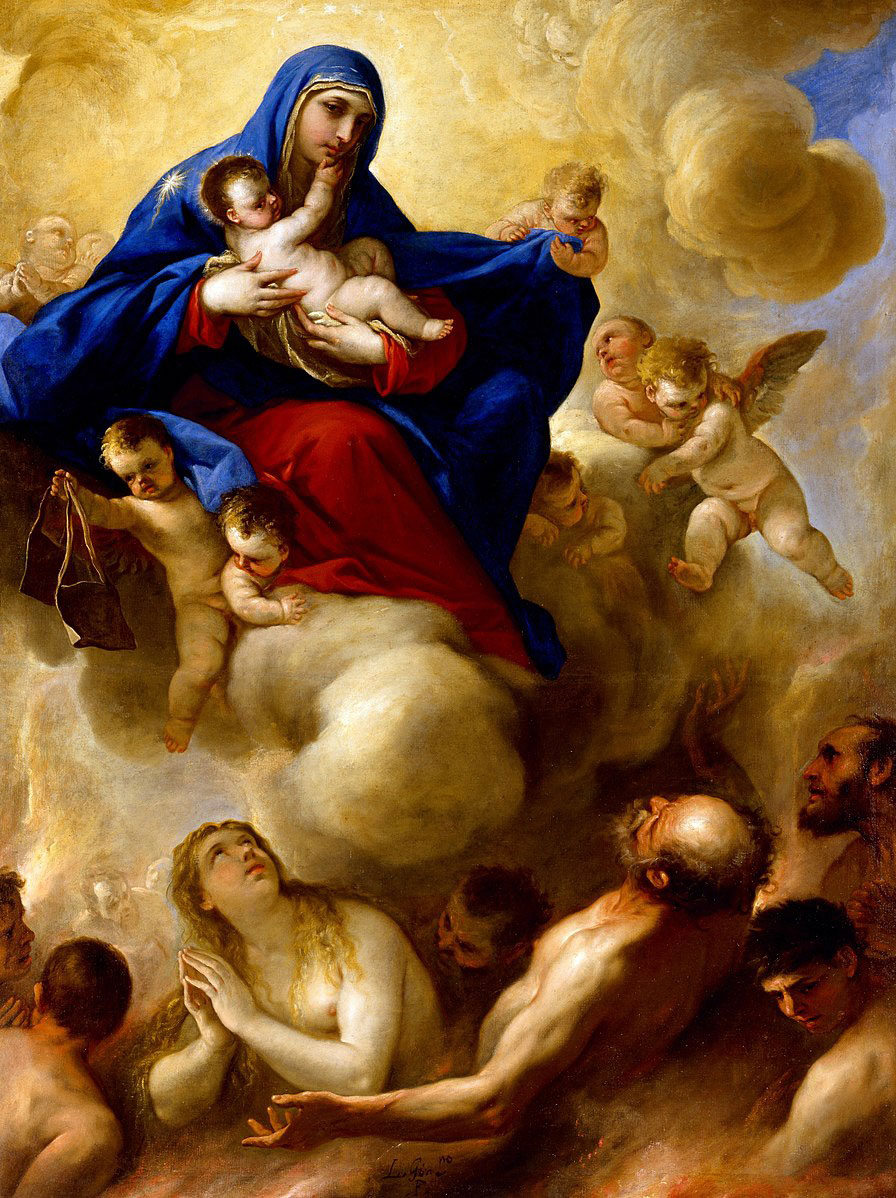
A plenary indulgence is the total remission of all temporal punishment due to sins that have already been forgiven, meaning it is understood as completely removing the remaining consequences of sin in Purgatory (“fixes all the windows”). To obtain a plenary indulgence, a person must receive the Eucharist on the day the indulgenced act is performed, go to sacramental confession within twenty days before or after that day, be completely detached from all affection for sin even venial sin, pray for the intentions of the Holy Father for that month, and complete the specific act of indulgence as prescribed. A plenary indulgence can be applied either to oneself or to any deceased person, and it can be obtained once per day.
More About Plenary Indulgences
Plenary Indulgences for the Common Person
What is a Plenary Indulgence?
Sacrament of Penance (Confession) removes the eternal punishment that our sins merit. But, once forgiven, the wounds and effects of our sins remain and block the full action of the Holy Spirit within us. The Church teaches that we must undergo “temporal” punishment either in this life or after death, (in Purgatory), to remove the effects of sin (after Sacrament of Penance- Confession) and prepare us for eternal happiness with God in Heaven.
- Temporal punishment may be removed while we are still on earth by voluntarily uniting our sufferings in this life with those of Christ and by our prayer and acts of charity.
- Temporal punishment also may be diminished or removed by a partial or plenary indulgence.
An indulgence is a favor granted to an individual by the Church— through the merits of Christ— that removes, either partially or completely (plenary), the temporal punishment that remains for sins that have been forgiven. This is a magnanimous grace of Mercy from God.
Keep in mind…Indulgences do not remove sin. That can only happen in the Sacrament of Penance which also removes the eternal punishment that our sins merit. A Plenary Indulgence completely removes the temporal punishment that remains for our sins that have been forgiven.
Who can gain an indulgence?
Catholics in full communion with the Church may obtain a plenary indulgence for themselves or for a soul in purgatory by carrying out an act of devotion (as listed below) with sincerity, following conditions set by the Church and be earnestly striving to eliminate all attachment to sin, whether moral or venial.
Four Conditions for Receiving an Indulgence, beyond the act for indulgence:
- Sacramental Confession within 20 days before or after the day the indulgence is sought
- Reception of Holy Communion
- Prayer for the intentions of the Holy Father
- Complete detachment from sin, even venial sin
Acts of Indulgence
3: Adoratio Ss.mi Sacramenti
Adoration of the Blessed Sacrament
A partial indulgence is granted the Christian faithful when they visit the Blessed Sacrament for the purpose of adoration. When this is done for at least half an hour, the indulgence is a plenary one.
13: Coemeterii visitation
Visiting a Cemetery
An indulgence is granted the Christian faithful who devoutly visit a cemetery and pray, if only mentally, for the dead. This indulgence is applicable only to the souls in purgatory. This indulgence is a plenary one from November 1 through November 8 and can be gained on each one of these days. On the other days of the year this indulgence is a partial one.
17: Crucis adoratio
Adoration of the Cross
A plenary indulgence is granted the Christian faithful who devoutly take part in the adoration of the cross during the solemn liturgy of Good Friday.
22: En ego, o bone et dulcissime Iesu
Prayer before a Crucifix
(Psalm 22:17-18; Roman Missal, pp. 935-936.)
Good and gentle Jesus,
I kneel before you.
I see and I ponder your five wounds.
My eyes behold what David prophesied about you:
“They have pierced my hands and feet;
they have counted all my bones.”
Engrave on me this image of yourself.
Fulfill the yearnings of my heart:
give me faith, hope, and love,
repentance for my sins,
and true conversion of life.
Amen.
On any Friday during Lent a plenary indulgence is granted the Christian faithful who, after communion, devoutly recite the above prayer before an image of Jesus Christ crucified. On other days of the year the indulgence is a partial one.
26: Iesu dulcissime
Act of Reparation to the Sacred Heart
Most loving Jesus, how great is the love which you have poured out upon the world. How casual and careless is our response!
Kneeling before you, we wish to atone for the indifference and the slights which pierce you to the heart.
R) Praise to the heart of Jesus, our Savior and our God.
We ask forgiveness for our own shameful neglect.
We wish to make amends for those who are obstinate in their unbelief, for those who turn away from the light
and wander like sheep without a shepherd, and for those who have broken their baptismal promises and reject the gentle yoke of your law.
R) Praise to the heart of Jesus, our Savior and our God.
We wish to make amends for the sins of our society:
for lust and degradation, for the corruption of the young, for indifference and blasphemy, for attacks against your Church, for irreverence and even sacrilege against your love in this Blessed Sacrament, and for the public defiance of your law.
R) Praise to the heart of Jesus, our Savior and our God.
These are the sins for which you died, but now we share in your atonement by offering on the altar in union with you the living sacrifice you made on the cross, joining to it the sufferings of your Virgin Mother, and those of all the saints and the whole Church.
R) Praise to the heart of Jesus, our Savior and our God.
We promise faithfully that by your grace we shall make reparation for our own sins and for those of others
by a strong faith, by holy living, and by obedience to the law of the Gospel, whose greatest commandment is that of charity.
R) Praise to the heart of Jesus, our Savior and our God.
We also promise to do our best to discourage others from insulting you and bring those we can to follow you.
R) Praise to the heart of Jesus, our Savior and our God.
Jesus, Lord, receive this loving act of homage together with the prayers of our Lady, who stood by the cross, our model in reparation.
Keep us faithful, even to the point of death, give us the gift of perseverance and lead us all to our promised land in heaven, where you, with the Father and the Holy Spirit, live and reign for ever and ever. Amen.
R) Praise to the heart of Jesus, our Savior and our God.
A partial indulgence is granted the Christian faithful who devoutly recite the above act of reparation. This indulgence will be a plenary one when this Act of Reparation is publicly recited on the solemnity of the Sacred Heart of Jesus.
27: Iesu dulcissime, Redemptor
Act of Dedication to Christ the King
Loving Jesus, Redeemer of the world, we are yours, and yours we wish to be.
To bind ourselves to you even more closely we kneel before you today and offer ourselves to your most Sacred Heart.
R) Praise to you, our Savior and our King.
Have mercy on all who have never known you
and on all who reject you and refuse to obey you:
gentle Lord, draw them to yourself.
R) Praise to you, our Savior and our King.
Reign over the faithful who have never left you,
reign over those who have squandered their inheritance, the prodigal children who now are starving: bring them back to their Father’s house.
R) Praise to you, our Savior and our King.
Reign over those who are misled by error or divided by discord. Hasten the day when we shall be one in faith and truth, one flock with you, the one Shepherd.
Give to your Church freedom and peace, and to all nations justice and order.
Make the earth resound from pole to pole with a single cry: Praise to the Divine Heart that gained our salvation; glory and honor be his for ever and ever. Amen.
R) Praise to you, our Savior and our King.
A partial indulgence is granted the Christian faithful who devoutly recite the above Act of Dedication to Christ the King. This indulgence will be a plenary one when this Act is publicly recited on the solemnity of our Lord, Jesus Christ, the King.
35: Obiectorum pietatis usus
Use of Devotional Objects
The Christian faithful obtain a partial indulgence when they make devout use of a devotional object (such as a crucifix or cross, a rosary, a scapular, or a medal) which has been rightly blessed by any priest or deacon.3
If the devotional object has been blessed by the Pope or by any bishop, the Christian faithful can obtain a plenary indulgence while making devout use of it on the solemnity of the holy apostles, Peter and Paul, provided they add to its use a profession of faith made in any legitimate formula.
This grant is taken from the apostolic constitution Indulgentiarum doctrina, norm 16. See also above, norm 19, p. 21.
48: Rosani marialis recitatio
Recitation of the Marian Rosary
A plenary indulgence is granted when the rosary is recited in a church or oratory or when it is recited in a family, a religious community, or a pious association. A partial indulgence is granted for its recitation in all other circumstances.
(The rosary is a prayer formula divided into twenty decades of Hail Mary’s with the Lord’s Prayer separating each of these decades. During each of these decades we recall in devout meditation the mysteries of our redemption.)
It has become customary to call but five such decades the “rosary” also. Concerning this customary usage then, the following norms are given as regards a plenary indulgence.
1. The recitation of a one set of Mysteries of the rosary is sufficient for obtaining the plenary indulgence, but these five decades must be recited without interruption.
2. Devout meditation on the mysteries is to be added to the vocal prayer.
3. In its public recitation the mysteries must be announced in accord with approved local custom, but in its private recitation it is sufficient for the Christian faithful simply to join meditation on the mysteries to the vocal prayer.
4. In the Eastern Churches where recitation of the Marian rosary as a devotional practice is not found, the patriarchs can establish other prayers in honor of the blessed Virgin Mary which will have the same indulgences as those attached to the rosary, (e.g., in the Byzantine churches, the Akathist hymn, or the office Paraclisis.)*
50: Sacrae Scripturae lectio
Reading the Sacred Scriptures
A partial indulgence is granted the Christian faithful who read sacred scripture with the veneration due God’s word and as a form of spiritual reading. The indulgence will be a plenary one when such reading is done for at least one-half hour.
59: Tantum ergo
Secret Past Imagination
Secret past imagination, dazzling and compelling awe;
Sacrament and celebration richer than the ancient law:
Faith can see by revelation more than senses ever saw.
Praise the Lord with exultation for the marvels he has done:
Blessing, power, and adoration to the Father and the Son
For creation and salvation; and the Spirit, Three in One.
Amen.
V) You gave them bread from heaven to be their food.
R) And this bread contained all goodness.
Let us pray: Lord Jesus Christ, you gave us the Eucharist as the memorial of your suffering and death. May our worship of this sacrament of your body and blood help us to experience the salvation you won for us and the peace of the kingdom where you live with the Father and the Holy Spirit, one God, for ever and ever.
R) Amen.
(Roman Ritual, Holy Communion and Worship of the Eucharist outside Mass, nos. 97 and 98.)
A partial indulgence is granted the Christian faithful who devoutly recite the above verses. The indulgence will be a plenary one on Holy Thursday after the Mass of the Lord’s Supper and on the solemnity of the Body and Blood of Christ during its liturgical rites.
60: Te Deum
You are God: We Praise You
You are God: we praise you;
You are the Lord: we acclaim you;
You are the eternal Father:
All creation worships you.
To you all angels, all the powers of heaven,
Cherubim and Seraphim, sing in endless praise:
Holy, holy, holy Lord, God of power and might,
heaven and earth are full of your glory.
The glorious company of apostles praises you.
The noble fellowship of prophets praises you.
The white-robed army of martyrs praises you.
Throughout the world the holy Church acclaims you:
Father, of majesty unbounded,
your true and only Son, worthy of all worship,
and the Holy Spirit, advocate and guide.
You, Christ, are the king of glory, the eternal Son of the Father.
When you became man to set us free you did not spurn the Virgin’s womb.
You overcame the sting of death, and opened the kingdom of heaven to all believers.
You are seated at God’s right hand in glory.
We believe that you will come, and be our judge.
Come then, Lord, and help your people, bought with the price of your own blood, and bring us with your saints to glory everlasting.
V) Save your people, Lord, and bless your inheritance.
R) Govern and uphold them now and always.
V) Day by day we bless you.
R) We praise your name forever.
V) Keep us today, Lord, from all sin.
R) Have mercy on us, Lord, have mercy.
V) Lord, show us your love and mercy;
R) for we put our trust in you.
V) In you, Lord, is our hope:
R) and we shall never hope in vain.
A partial indulgence is granted the Christian faithful who recite the hymn, Te Deum, as an act of thanksgiving. The indulgence will be a plenary one if this hymn is publicly recited on the last day of the year.
61: Veni, Creator
Come, Creator Spirit
O Holy Spirit, by whose breath
Life rises vibrant out of death;
Come to create, renew, inspire;
Come, kindle in our hearts your fire.
You are the seeker’s sure resource,
Of burning love the living source,
Protector in the midst of strife,
The giver and the Lord of life.
In you God’s energy is shown,
To us your varied gifts made known.
Teach us to speak, teach us to hear;
Yours is the tongue and yours the ear.
Flood our dull senses with your light;
In mutual love our hearts unite.
Your power the whole creation fills;
Confirm our weak, uncertain wills.
From inner strife grant us release;
Turn nations to the ways of peace.
To fuller life your people bring
That as one body we may sing:
Praise to the Father, Christ, his Word,
And to the Spirit: God the Lord,
To whom all honor, glory be
Both now and for eternity. Amen.
Alt. Rabanus Maurus (776-856); tr. John Webster Grant (b.1919), alt. (Hymnbook 1982, no. 502).
A partial indulgence is granted the Christian faithful who devoutly recite the hymn, Veni, Creator. The indulgence will be a plenary one when this hymn is recited publicly on the first day of January and on the solemnity of Pentecost.
63: Viae Crucis exercitiu
Stations of the Cross
A plenary indulgence is granted the Christian faithful who devoutly make the Stations of the Cross. This devout exercise of the Stations of the Cross helps renew our remembrance of the sufferings that our divine redeemer underwent on his journey from Pilate’s praetorium, where he was condemned to death, to Mount Calvary, where for our salvation he died on the cross.
The norms for obtaining this plenary indulgence are the following:
1. This devout exercise must be performed before stations of the cross that have been lawfully erected.
2. Fourteen crosses are required in order to erect the Stations of the Cross. As an aid to devotion these crosses are customarily attached to fourteen tableaux or images representing the Jerusalem stations.
3. In accord with the more common custom, this devout exercise consists of fourteen pious readings to which are joined some vocal prayers. But in order to perform this devout exercise it is required only that one devoutly meditate upon the passion and death of the Lord. It is not required that one meditate upon each of the individual mysteries of the stations.
4. Movement from one station to the next is required. If this devout exercise is carried out publicly and such movement by all present cannot be done without some disorder, it is sufficient that the person who is leading the exercise move from station to station while the others remain in their places.
5. Persons who are legitimately prevented from fulfilling the above requirements can obtain this indulgence if they at least spend some time, e.g., fifteen minutes, in devout reading and meditation upon the passion and death of our Lord Jesus Christ.
6. Equivalent to this devout exercise of the Stations of the Cross — even with regard to obtaining the indulgence — are those other devout exercises which have been approved by competent authority and which call to mind the remembrance of the Lord’s passion and death in a manner similar to the Stations of the Cross.
7. In order to obtain this indulgence, the patriarchs can establish some other devout exercise in memory of the passion and death of our Lord Jesus Christ for those Eastern Christian faithful whose usages do not include this exercise of the Stations.
65: Visitatio ecclesiae paroecialis
Visiting a Parish Church
A plenary indulgence is granted the Christian faithful who devoutly make a visit to a parish church:
1) on its titular feast day;
2) on August 2, the day on which the Portiuncula indulgence occurs.
These same indulgences can be obtained either on the days mentioned above or on other days determined by the ordinary so that the faithful can take better advantage of them. The same indulgences are also attached to the cathedral church and, if there be one, to the co-cathedral church, even if neither of these is a parish church. They are also attached to a quasi-parish church.
These indulgences are already contained in the apostolic constitution, Indulgentiarum doctrina, norm 15. They are included here in light of the Sacred Penitentiary’s deliberations since the constitution was issued. According to norm 16 of the apostolic constitution, this visit is to include the “recitation of the Lord’s Prayer and the Creed (Pater and Credo).”
67: Visitatio ecclesiae vel oratorii in Commemoratione omnium fidelium defunctorum
Visiting a Church or an Oratory on All Souls Day
A plenary indulgence, which is applicable only to the souls in purgatory, is granted the Christian faithful who devoutly visit a church or an oratory on All Souls Day.
This indulgence can be obtained either on the day mentioned above or, with the consent of the ordinary, on the preceding or following Sunday or on the solemnity of All Saints.
This indulgence is already contained in the apostolic constitution, Indulgentiarum doctrina, norm 15. It is included here in light of the Sacred Penitentiary’s deliberations since the constitution was issued.
According to norm 16 of the apostolic constitution, this visit is to include the “recitation of the Lord’s Prayer and the Creed (Pater and Credo).”6
70: Votorum baptismalium renovatio
Renewal of Baptismal Promises
A partial indulgence is granted the Christian faithful who renew their baptismal promises through any customary formula. When they do this during the celebration of the Easter Vigil or on the anniversary of their own baptism, they obtain a plenary indulgence.
V) Do you reject sin so as to live in the freedom of God’s children?
R) I do.
V) Do you reject the glamor of evil and refuse to be mastered by sin?
R) I do.
V) Do you reject Satan, father of sin and prince of darkness?
R) I do.
V) Do you believe in God, the Father almighty, creator of heaven and earth?
R) I do.
V) Do you believe in Jesus Christ, his only Son our Lord, who was born of the Virgin Mary, was crucified, died, and was buried, rose from the dead, and is now seated at the right hand of the Father?
R) I do.
V) Do you believe in the Holy Spirit, the holy catholic Church, the communion of saints, the forgiveness of sins, the resurrection of the body, and the life everlasting?
R) I do.
V) This is our faith. This is the faith of the Church.
We are proud to profess it in Christ Jesus our Lord.
R) Amen.
70: Divine Mercy Sunday
The plenary indulgence is granted (under the usual conditions of a sacramental confession, Eucharistic communion and a prayer for the intentions of the Supreme Pontiff) to the faithful who, on Divine Mercy Sunday, in a spirit that is completely detached from the affection for a sin, even a venial sin, recite the Our Father and the Creed, and also adding a devout prayer (e.g. Merciful Jesus, I trust in you!).